
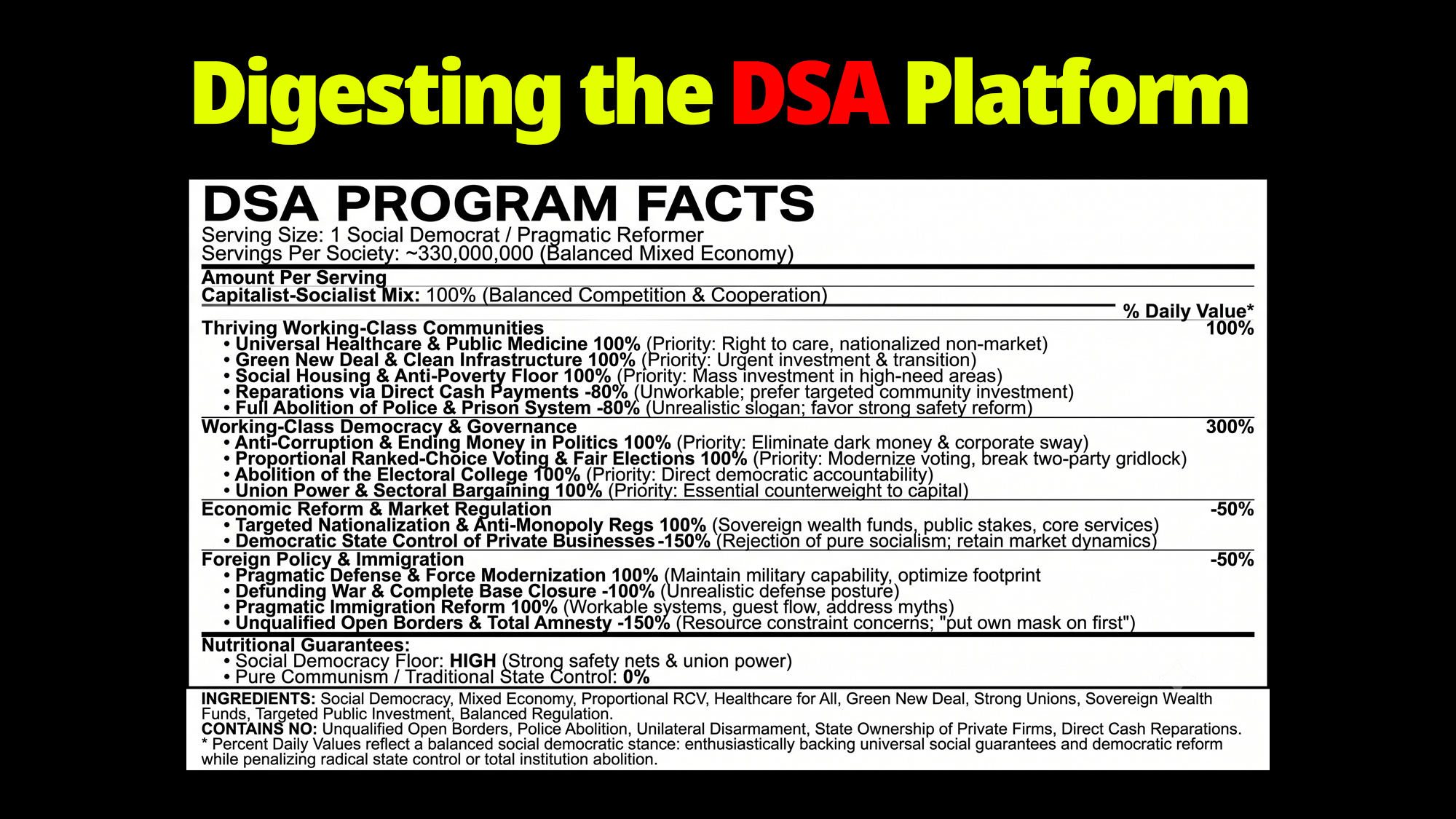
I have mixed opinions on the DSA's National Program, and a lot of questions. That's a healthy position for anyone to have about any platform or program. Especially when the goals are ambitious, and the details are few.
Ultimately, I ended up becoming a dues-paying member of the DSA, just like with my county's Democratic Party. Here is what went into the decision.
First the big rock. I am into social democracy; traditional socialism or communism are both a no for me.
Our economy is a mix of capitalism and socialism, as is almost every economy in the world. The mix of competition and cooperation is here to stay for a long time because it's a winner when it's balanced appropriately.
The socialist elements of our economy are under-powered, and both the capitalist and socialist components aren't functioning well. The impact of money on politics is toxic to functioning markets, and our welfare programs are expensive and inefficient. The lack of a balancing force from labor unions is preventing people from projecting enough power to enact pro-social reforms to establish a floor which we will not let people fall below.
Adam Smith is currently rolling over in his grave. Give him a read, Karl Marx did, that's where he got a lot of his material.
Dr. Alexander D. Wissner-Gross believes we will see post-capitalism one day, but there will be a quadrillionaire first. Once we're expanding into space and have reached Star Trek-level technology and abundance, anything is possible. It's a spectrum we progress along between now and then. So what does that look like?
Progress According to DSA Establishment
A look at the DSA's What We Fight for section shows us the direction they believe we should go. It separates their goals into three areas with multiple topics. Each topic is presented as a single paragraph.
First, there are a lot of goals that I am an enthusiastic yes to. Things like healthcare for all, housing for all, and a Green New Deal are a few examples. As they say, the devil is in the details, but these are areas we need to prioritize.
Then there are goals I have various degrees of disagreement with. Here are a few.
Enact reparations and massively invest in good jobs, quality housing and infrastructure in neglected minority communities.
If by reparations this means direct payments, that is a non-starter. You can never repay for what was done, but you do have to reckon with it. We should place massive investment where the greatest needs are. When we invest in those places, we are addressing a lot of the injustice that remains today.
Direct cash payments are not workable or productive. They are trying to cure injustice with more injustice.
Fully abolishing the police and prison system
The Wisconsin DOT has a program called Zero in Wisconsin. The goal is 0 deaths on Wisconsin highways. Nice goal, maybe it's realistic once we reach fully automated driving, but it's still not likely.
America does have a prison problem. America does need policing reform. As an attention-grabbing slogan, it's one of the top problems people have with the program, myself included.
Having an economy that provides greater opportunity for life, liberty, and the pursuit of happiness will solve some problems, and we will always need law enforcement.
Defund the Department of War. End all foreign wars and close overseas military bases.
Having a military is a requirement. We should always prefer to have the most capable military in the world rather than not. We need to rethink our footprint and how we defend our nation. We need our military to do more with less, which will be a challenge given the new area for force projection, space.
Establish public ownership of the largest corporations and essential industries to ensure democratic control and accountability to the people.
There is something to this, but it may not look exactly like people think.
On ownership, we are already seeing some of this from the Trump administration. Call it a sovereign wealth fund, state capitalism, it doesn't matter. Stocks or public ownership is an alternative to taxation as a means to get corporations to pay their share of the cost of running society. In hindsight, we should have done some of this when we bailed out the financial industry in 2008.
On democratic control, some markets, like health care, are critical to fundamental rights and don't function properly as markets. They should be nationalized. Most developed countries have done this; as a latecomer we can learn from what works and what doesn't. The other part of democratic control is the types of regulations and restrictions we enact within markets, preventing monopolies or consumer abuse.
There is room for ESOPs and other structures, but individual companies, for the most part, shouldn't be democratically controlled by the government.
Legalize migration, grant amnesty for all immigrants regardless of status, provide a path to citizenship for all permanent residents, and end visa caps and quotas.
Unqualified open borders is a bad idea. We have a hard enough time collaborating and using the resources we have as is. As they say in the airline industry, put on your own mask before helping others.
There is immigration reform in that direction worth discussing. Before we closed borders, immigrants would come to America for jobs when unemployment was low and leave when the jobs weren't available. With closed borders, those same people come to work and stay in the lean times, unsure if they will be able to return later. Not only do they stay, but they also bring their families.
Everyone wants immigration reform. Myths about the problem and the often silent influence of businesses who take advantage of the current situation prevent it.
Working Class Democracy
The prevailing attitude in America is we don't like or trust our government. At the same time, we don't talk about what we should do to fix it. Rotating new politicians into a broken system isn't going to fix anything.
The Heritage Foundation sunk $22 million dollars into a plan, and having that plan helped their candidate make change once elected. Unfortunately, Project 2025's policies are both unpopular and unwise. The best we can hope for is a kintsugi project.
Kintsugi is the art of repairing broken pottery by mending it with lacquer dusted with gold powder. The finished product is stronger for the mending.
Some of these ideas are used as rage bait, but they should be seen as an opening to a discussion. The founders of our government gave us the tools to create laws and even amend our Constitution. Kudos to anyone starting a real conversation about what could improve our nation.
These are the things in this category we should center immediate discussion around.
- Proportional ranked choice voting see FairVote
- Abolishing the electoral college
- Progressive taxes
- Unions, including sectoral bargaining
- Ending the corrupting influence of money on elections and governing
- Protecting voters' rights
- and more...
Wrap
I have a lot of enthusiasm for the goals around thriving communities and democracy. These should be our priorities, even if you don't agree with the specific policies.
Joining either is not a marriage. You can help with the areas you like and leave the rest. You can support candidates you want, and not vote for the rest. You can vote and work within the group to change direction, like any other member.
The local members I work with made a difference in my choice as well. A majority of the work they do has nothing to do with politics. I first met local members through movement organizing. The organization has a reputation for working their ass off helping people, and the members I know do just that.
This isn't a binary choice between DSA or traditional Democratic platforms. We all have our own thoughts about policies and priorities. We use those to select candidates we think best align with our thoughts. The candidates with the best alignment win and have power over policy until the next election.
We should all be happy to have people we can vote with that share enough common opinions on policy.