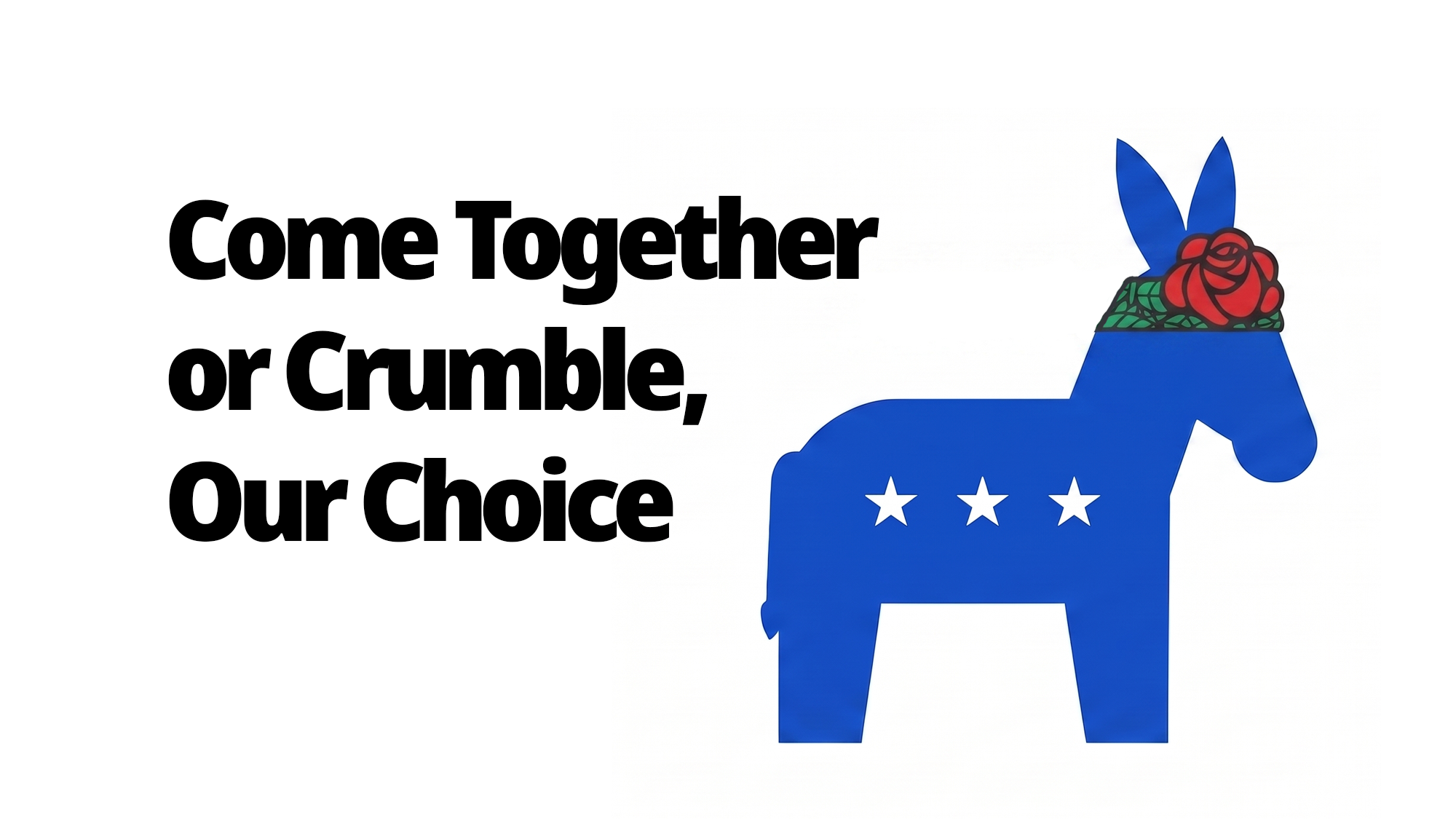
Politics has become the year-round blood sport driving news cycles in America. Lately, the 24/7/365 news cycle is obsessed with highlighting drama between the Democratic Party and the Democratic Socialists of America (DSA).
The reality is it’s a great opportunity, but the next two election cycles are critical.
The Democratic Party is widely considered the oldest active party in the world. Its recent defeat in the 2024 election left the party bruised, but losing an election never ended a political party. It’s still got infrastructure, dedicated voters, and plenty of elected officials. It also stands to do quite well in the next two election cycles based on typical cycles and the abysmal performance of the Republican Party.
The DSA has been around since the early 80s, but really only gained any traction with Bernie Sanders' runs for President and the success of a few other upstart politicians. It’s got some phenomenal star power in young elected officials, truly dedicated volunteers, but low membership. It needs the Democratic Party for ballot access and inroads to voter attention.
I've shared my take on the importance of the label socialist. Polls indicate the term is not favorable outside of the Democratic Party. Inside the Democratic Party, it is well “above water”, especially with younger generations. In short, for both Dems and DSA, the future is pretty bleak if they don’t find a way to make it work.
Thomas Jefferson once wrote that if he couldn't go to heaven but with a party, he wouldn't go there at all. Policy is the goal, and people are what matters; parties are just a vehicle.
Thankfully, there is plenty of overlap on top priorities to keep everyone busy for some time. We don’t have a core compatibility problem; we need leadership to help us transition through this phase.
That leadership is not going to come from the establishment within either party. They see this as a turf war, in which we, the voters, are the turf.
We can hope to see it from individual politicians. Indeed, this is what we will need to cement things, but that top-down alignment is only part of the answer. Right now we need grassroots leadership. What does that look like?
It looks like people building solidarity from the ground up. Political parties are made up entirely of people, so it starts by getting curious and connecting with people in your community. My curiosity started with a slice of pizza.
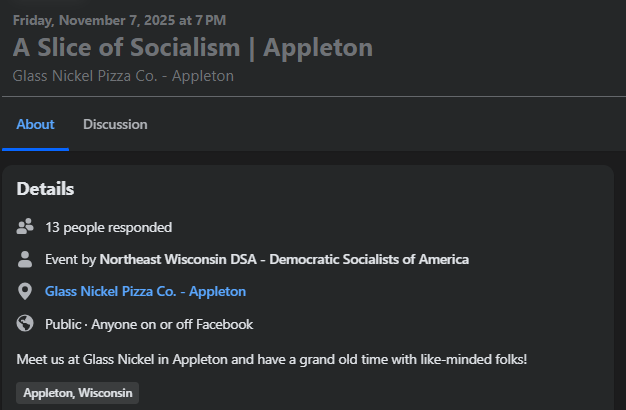
One day I came across a Facebook event called a Slice of Socialism. The event, held at a local pizza joint, was a half dozen people, myself included, sharing pizza and getting to know each other. This was just after Mamdani’s victory, and other than celebrating the voters in New York, it was non-political. Great start.
I am active with the Democratic Party of Outagamie County, so I wasn’t looking to get involved. Since Trump’s victory, that looked like movement organizing and marshaling for No Kings protests throughout NE Wisconsin. In movement organizing, you get to meet a lot of new people. There were some regulars showing up to help with No Kings that I quickly grew to like.
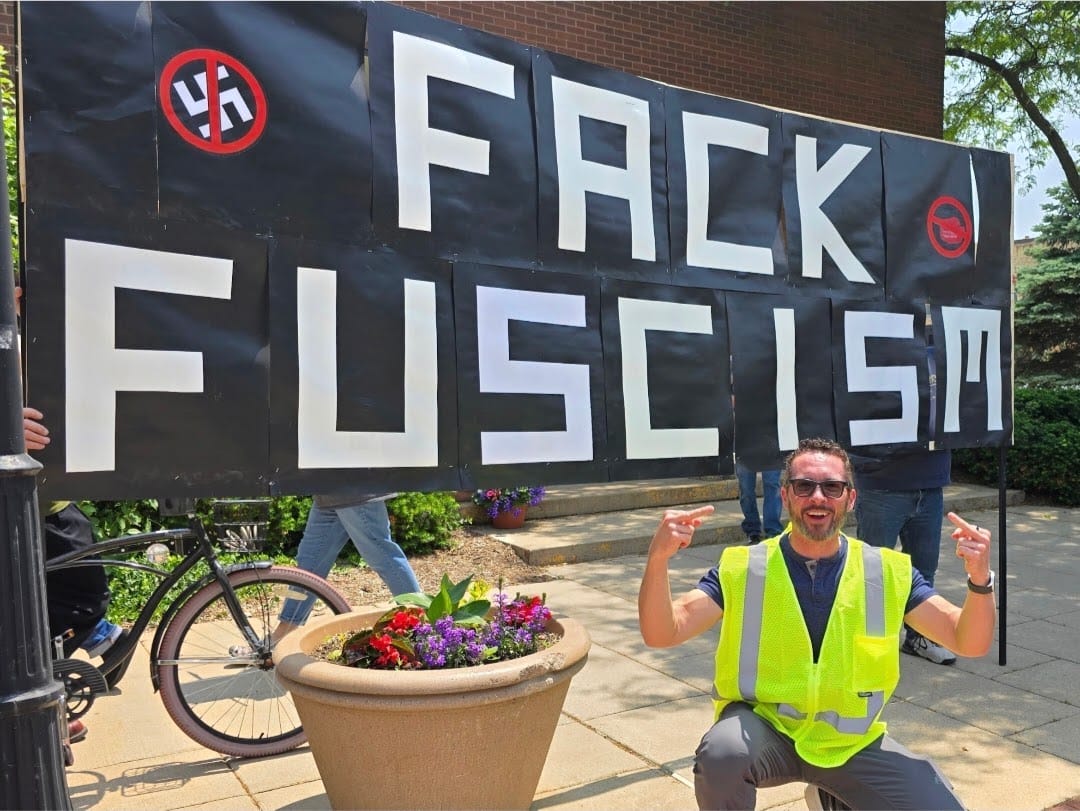
When I started volunteering for Francesca Hong’s campaign, I realized some of the people I appreciated working with on No Kings were DSA. The fact that she was a member wasn’t on my mind when I decided. Her personal platform and leadership are what won me over. Around this time, I checked out the formal platform of the national party. Now I had some questions.
I've got a take, but I'm saving it for another day.
I didn't want to read too much into a manifesto written by a committee. I got curious about what people thought. It was time to leverage the relationships I was building to have honest and possibly challenging discussions. An upcoming social event sounded like the perfect opportunity to talk a little bit about policy.
The event took place in a dimly lit hall in the back of a local bar. The back half of the room was laid out with sofas and chairs, providing space for a few different conversations. Someone had brought a platter of cookies, which I picked up and offered to the different groups as an easy in to a conversation.
I found my way into a group of 5 people, all fairly young, and leveraged my favorite canvassing bridge-building question. What issue motivates you to vote? Although this was a state-level race, the topic of Israel came up.
Although we agreed about 85% on the issue, the discussion was still highly contentious. There were moments when the language used by one side or the other nearly derailed everything. At one point, one of them quite literally said, "We are done here," but we kept working through it until we at least understood where we agreed and where we didn't.
The topic also branched into the military, China, and immigration. We spent less time there, but it did offer some opportunities. First, it helped me gauge what they knew and what they didn't. Second, it allowed me to plant some seeds for thought.
I could see my younger self in their viewpoint, so I certainly understood the spirit. They broke out the line about people getting more conservative as they get older. I bristled a little at the term conservative; I'd prefer the word grounded. For example, while current Israeli policy isn't something we should be funding, they aren't the only actor in the Middle East that has done bad things.
By the end of the event, I had found what I was looking for. At times the conversation was difficult, but I appreciate the fact that people were willing to have hard conversations.
The Wisconsin primary is coming up in a few weeks. People involved with both the DSA and the Democratic Party of Outagamie County are looking to organize a joint watch party. There is already a lot of camaraderie across groups. I’m sure the event will strengthen those ties and build more.
No matter who wins, we will need the combined group to help aligned candidates win in our battleground state. Every time we collaborate to help our community through movement or political organizing, that is where the growth is. That is how we come together.
We all lead our own lives, which makes us all leaders.
Grassroots leadership from joint events to one-on-one conversations with goodwill is the difference between a crisis and a generational opportunity. We can’t wait for top-down leadership to bring us together. We have to lead in our own communities, building these bridges ourselves from the bottom up.
On this team, we fight for those votes, then we fight for the people.