
We place too much emphasis on terms like conservatism, liberalism, capitalism, and socialism. We label each other with them and argue about them as if it makes a difference. Most of us don't even know their meanings.
Wikipedia says an ism is for making an abstract noun.
Don't get me wrong, words matter. They have definitions, and in different contexts, their meanings vary. Over time, even dictionary definitions change. The folks at Merriam-Webster and Oxford change word meanings to reflect how we use them, not to reflect new understandings of their historical roots.
The first vote I cast was in the 2000 Presidential election. I voted for Gore because of his positions on climate change and environmental issues. Ever since, I've continued to vote Democrat and, by extension, have had the term liberal applied to me. That could be either a curse or a blessing, depending on who uses it.
If asked to define what liberalism was or what it meant to be a liberal, I would have struggled to put it into words. I would have said something about individual rights, protecting human dignity, and change towards those ideals. The person I was talking to would likely have a different idea of what liberalism meant.
Neither of us would be likely to draw the important distinction between the words liberal and liberalism.
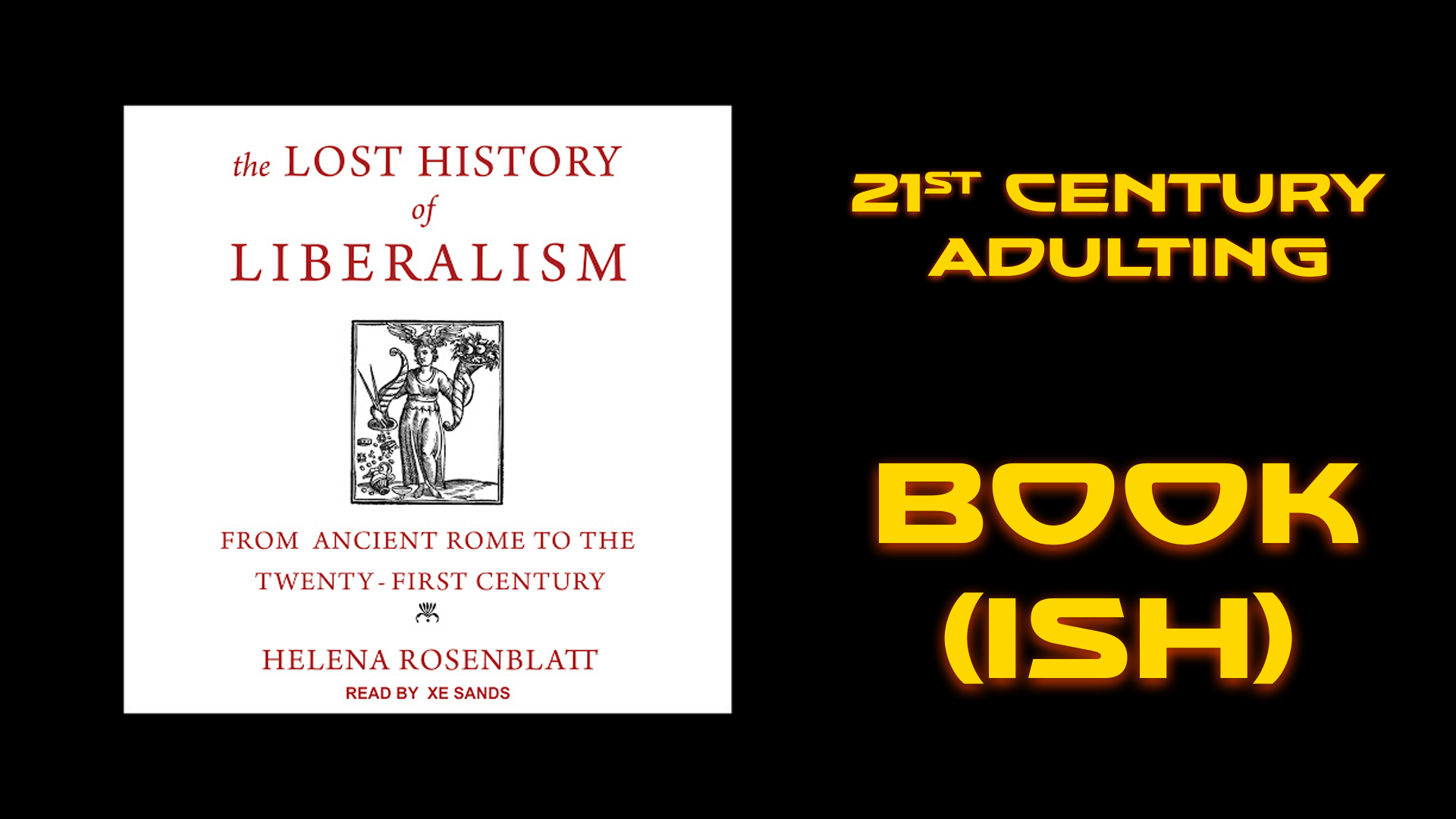
So, I decided to dig into the technical definition. That led me straight to the audiobook preview of the Lost History of Liberalism.
The preview led to a purchase of the full audiobook, which was devoured in a little over a week. It delivered on both the title's promise and my view of the word's value.
The book covers over 2000 years of history, chronologically. Starting with authors like Cicero and Seneca in the last century BC, and ending in the modern era. The bulk of the time is focused on the 18th and 19th centuries.
In Rome, authors such as Cicero and Seneca defined the word liber as free and generous, the opposite of selfishness. Liberalis was "benefiting a free-born person". It was the glue that bound a society together through a system of exchange.
The use of the term liberalism and its predecessors is traced through three primary domains: politics, religion, and economics. Religion and politics were deeply intertwined in Europe for most of the last two millennia. As the two domains went through a messy divorce over hundreds of years of war, and the science of economics was born, the use of the word got more confusing.
The term liberalism was coined in France in 1811. This is a time when the liberal idea had reached new heights with the rise of the United States. France was between the first two of its three revolutions, following centuries of an oppressive monarchy intertwined with the church.
This coincided with the formal birth of economics in the publication of Adam Smith's Wealth of Nations. Now the term liberalism spanned three domains. Being new, it was subject to wide disagreement and, at times, intentional misunderstanding in the face of resistance to the move away from the old but familiar monarchy of throne and altar.
All this reinforces the value of ism words in most of our discussions. They are a distraction at best.
Abstract nouns and ideologies make for great discussions about theory. Ideologies are incomplete and never fully implemented as systems. Look at economics as an example. Many argue about socialism or capitalism, ignoring the fact that both are only theories. The reality is that the United States is a mix of both. As is every economy in modern times.
Too often, we label and generalize. It's an easy shift of the discussion when we don't know how to make our case or can't agree to disagree. We should spend more time talking about concrete policy than theoretical ideology.
Even then, we need to refocus on values, then dive deeper into all aspects of one issue. Instead, we zoom out, broadly mischaracterize, and draw battle lines. We feel the need to get to the bottom of things immediately. There is time, and there is no bottom of things.
The magic is in the interplay between values and any mix of systems (the isms).
Look back to the founding of America. The Declaration of Independence was the easy part. We had a common enemy, and making a united statement of our values was relatively easy. Kumbaya.
When it came time to actually implement a system of governance, it was hard. They had to clearly define what the values meant and how best to strive for them. All the while knowing humans are imperfect, and the systems we devise are as well.
Emphasizing conservatism or liberalism is a fool's game. It is pretending there is a well-defined, foolproof implementation plan stretching from here to eternity.
Next time your discussion is devolving into an argument about an ism, stop. Take a moment to find agreement and complement between liberal and conservative values.
We don't have to agree on a fully formed path to an ultimate destination. We have to find the next step forward towards shared values, free of allegiance to any ill-defined changing ism.
The founders of our nation knew a perfect nation was unattainable, but a more perfect union was a goal worth the compromise and effort.
T
-
Of note:
If you're not ready to commit to the book, Ezra Klein just interviewed the author. Check it out.